


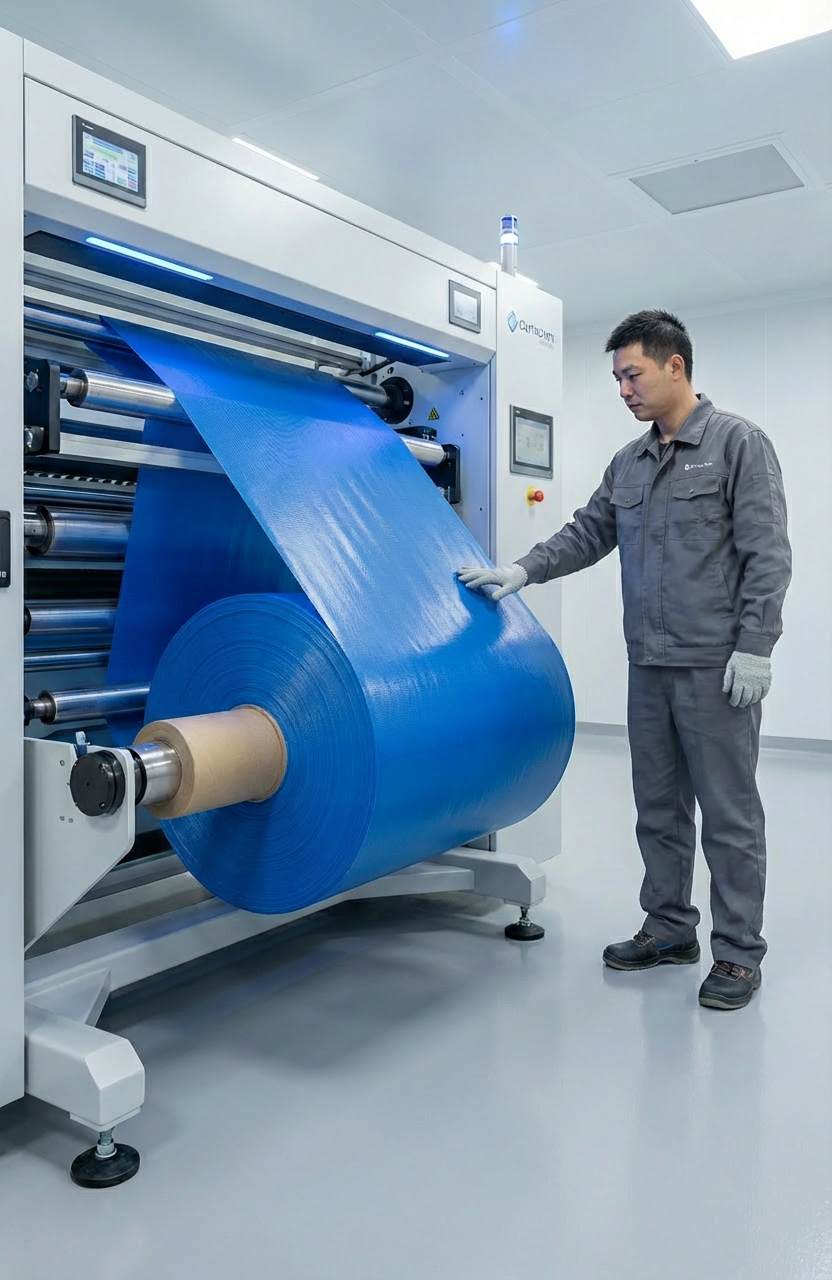
In medical device manufacturing, quality isn’t something you check at the end. It’s built in from the start. For inflatable products—think compression sleeves, blood pressure cuffs, or respiratory masks—the coated fabric is literally the heart of the device. If that material fails, the device fails. And we all know what that means in a hospital setting.
At [Your Company Name], we don’t treat quality as a department. It’s just how we run the line. Every single day. This blog walks you through our 5-step quality control process—no fluff, just what we actually do to make sure every roll of medical-grade TPU-coated fabric leaves right.
Incoming Raw Material Inspection – It Starts with Purity
You can’t make good material from bad ingredients. That’s not deep wisdom; it’s just fact.
Before anything hits our production line, we inspect every incoming batch. Not a spot check. Every batch.
What we look at:
- TPU resin – We only buy pharmaceutical-grade pellets from traceable, reputable suppliers. Each lot comes with a Certificate of Analysis (CoA). We check molecular weight distribution, melt flow index, moisture content, and monomer residue. If something doesn’t match our spec sheet? Rejected. No debate.
- Fabric substrate – Nylon, polyester, or whatever the job requires. We verify denier, yarn count, weave density, weight per square meter, and surface finish. We use calibrated instruments—analytical balances, yarn counters—to catch any deviation before it becomes a problem.
- 첨가제 – Color masterbatches, stabilizers, processing aids. Every single one needs an MSDS and biocompatibility data. No phthalates. No heavy metals. No unapproved chemicals.
Bottom line: If the raw material doesn’t pass, the production line doesn’t start. Simple as that.
In-Process Monitoring – Watching the Line in Real Time
Once we start coating, we don’t just let the machine run and hope for the best. Our coating lines are instrumented with real-time sensors that constantly feed data back to the control room.
Key things we monitor live:
- 코팅 두께 – Non-contact beta gauges or IR sensors measure wet and dry film thickness down to the micron. Tolerance is typically ±0.01mm. Anything outside that range triggers an automatic alert, and the system adjusts doctor blade or roller speed immediately.
- Temperature profile – TPU coating requires precise melting and curing. We digitally log extruder temperatures, coating head temps, and each oven zone. This isn’t “set and forget.” We watch it continuously to ensure proper flow, cross‑linking, and adhesion.
- Surface defects – High‑resolution line‑scan cameras run the full width of the fabric. They catch pinholes, inclusions, streaks, or scratches that you couldn’t see with the naked eye. Every defect gets flagged and logged for final review.
Real talk: This step catches problems early. Before they turn into bad rolls.
Physical Performance Testing – Simulating Real-World Abuse
Passing online monitoring is one thing. Surviving a hospital environment is another.
That’s why we pull samples from every production run and bring them to our in‑house lab. We test to failure. Literally.
Mechanical tests we run:
- Tensile strength & elongation (ASTM D5035) – How much pull can it take before it rips? We need numbers, not guesses.
- Tear strength (ASTM D5587) – Once a tear starts, does it spread? For inflatable devices, low tear propagation is critical.
- Peel strength (ASTM D903) – This measures how well the TPU coating bonds to the fabric. Weak bond = delamination = device failure. We don’t accept weak bonds.
Performance tests:
- Hydrostatic pressure resistance (AATCC 127) – Tells us how well the fabric holds back water. It’s also a good proxy for air tightness.
- Air permeability (ASTM D737) – For bladder applications, this needs to be near zero. We measure it precisely.
- Dimensional stability (creep & relaxation) – We apply load under controlled temperature and humidity to see if the material stretches over time or loses tension. Low values mean your device keeps its shape and pressure cycle after cycle.
Why this matters: These tests don’t just tell us if the material meets a spec. They tell us if it will survive real use—folding, cleaning, inflating, deflating, over and over.
Biocompatibility & Chemical Safety – The “Medical-Grade” Reality Check
This is where a lot of suppliers talk a big game. We’d rather just show you the test reports.
Our “medical-grade” claim isn’t marketing. It’s backed by data.
What we do:
- Batch‑level biocompatibility verification – Even though our formulation is fixed, we regularly (every lot or quarterly) send samples to an ISO 17025‑accredited independent lab. Tests include:
- USP cytotoxicity – L929 mouse fibroblast cells. If the material kills cells or stunts growth, it fails.
- ISO 10993‑10 skin irritation & sensitization – We use validated in vitro methods to assess risk.
- Leachables monitoring program – Once a year (or more often if needed), we perform extraction studies using simulated body fluids (saline/ethanol). Then we run GC‑MS and LC‑MS to see what—if anything—could migrate out of the material. Then we compare against toxicological concern thresholds. No surprises.
- Certificate of Conformity (CoC) – Every roll ships with a CoC that references the relevant biocompatibility test reports (USP Class VI, ISO 10993‑5, ‑10, etc.). That’s direct traceability from our lab records to your receiving dock.
Honest statement: We can’t claim zero risk—nothing in medical materials is absolute. But we can show you exactly what’s in our material, what we’ve tested for, and what we found.
Final Inspection, Packaging & Traceability – The Last Gate
This is the final check before material goes out the door. We combine human eyes with machine precision.
Final inspection:
- 100% visual re‑inspection – Trained inspectors look at every meter of fabric on dedicated light tables. They check for color consistency, texture uniformity, edge defects—things the automated cameras might miss.
- Spot tests from each roll – We cut samples from the head and tail of every finished roll. Quick lab tests: thickness, grammage, bond strength. This confirms that the online data and the lab data match the actual finished roll.
포장:
- 각 롤 코어에는 고유한 로트/롤 번호 바코드가 부여됩니다. 이 코드는 생산일자, 라인 번호, 원료 배치 및 모든 시험 결과와 연결됩니다.
- 우리는 습기에 강하고 먼지가 들어가지 않는 재료로 포장합니다. 좋은 롤은 잘못된 보관이나 운송으로 인해 손상될 수 있기 때문입니다.
서류:
모든 배송품에는 다음이 포함됩니다:
- 적합성 증명서
- 기술 데이터 시트(주요 시험 데이터 포함)
- 안전 데이터 시트
모든 서류에는 롤 번호가 기재되어 있습니다. 따라서 어떤 자료나 공정, 시험을 추적해야 할 경우 언제든지 가능합니다.
품질은 체크리스트가 아니라 하나의 줄기입니다
우리의 5단계 품질 관리 과정은 우리가 스스로 기분 좋게 하기 위해 체크하는 체크리스트가 아닙니다. 그저 우리가 일하는 방식일 뿐입니다.
원료 수지 알갱이가 우리 부두에 도착하는 순간부터 완제품 롤이 포장되고 라벨링되는 순간까지, 우리는 늘 주의를 기울이고 있습니다. 이는 의무적이어서가 아니라, 여러분의 장비가 그것에 의존하기 때문입니다.
당사의 TPU 코팅 직물을 선택하실 때, 단순히 재료를 사는 것이 아닙니다. 그것은 롤 안에 무엇이 들어 있는지를 입증하는 일련의 결정과 시험, 기록을 사는 것입니다. 이는 여러분에게 더 적은 위험을 의미합니다. 더 빠른 규제 승인을 가능하게 하고, 궁극적으로는 매번 제대로 작동하는 의료기기를 제공합니다.
품질은 특정 부서가 아닙니다. 그것은 우리가 하는 모든 일에 스며든 줄기입니다.
맞춤형 중국어 버전(같은 ‘자연스러운 어조’를 사용) 또는 한 페이지 분량의 데이터시트용으로 간략화된 버전이 필요하시면 알려주세요.
 English
  Spanish
  Italian
  Korean
  French
  Japanese
  Arabic
  Portuguese
  Vietnamese
  German
  Turkish
  Belarusian